

The scientific community became interested in the interstellar comet 3I/ATLAS once more when recent studies showed the presence of organic compounds like methanol, cyanide, and methane in its makeup. These compounds are associated with life chemistry on Earth, but can also form through non-biological processes.
Comet 3I/ATLAS continues to captivate researchers.
Researchers were intrigued by another aspect besides the chemical composition. Roughly two months after reaching the closest point to the Sun, comet 3I/ATLAS experienced a sudden and significant increase in brightness, a behavior commonly seen in comets as they release gas and dust due to ice sublimation.
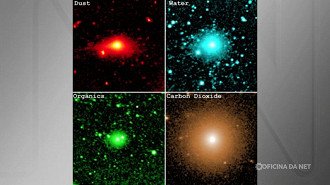
The phenomenon suggests that carbon-rich materials remained active long after the peak of solar heating for this interstellar visitor.
The comet experienced a “space blast” in late 2025, during which the Sun’s heat gradually penetrated its outer layers, leading the deepest ice to transform into gas shortly after it reached its closest point.
This clarifies why the increase in brightness was not immediate, unlike what typically occurs with more common comets.
What does 3I/ATLAS refer to?
Discovered on July 1, 2025, using the ATLAS telescope in Chile, 3I/ATLAS is just the third interstellar object observed passing through our Solar System. It earned this designation due to its hyperbolic trajectory, indicating that it is not bound by the Sun’s gravity and will not return after its journey.
The James Webb Space Telescope’s observations showed that the gas cloud surrounding the comet, known as the coma, contains a high amount of carbon dioxide (CO2), unlike other comets studied. This indicates that comet 3I/ATLAS was formed under unique conditions compared to icy bodies in our solar system.
The information suggests that the comet travels at a speed of around 221,000 kilometers per hour, making it too quick to be caught by the Sun. Computational simulations suggest that it could be more than seven billion years old, possibly older than the Solar System. Scientists see each new observation of 3I/ATLAS as a valuable chance to learn about the formation and development of other planetary systems.
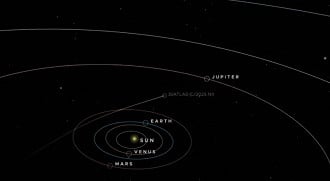
The comet has followed an impressive trajectory through the Solar System since its discovery. In late September and early October, it passed relatively near Mars, just over 30 million kilometers away, enabling NASA probes to collect detailed data.
In late October, 3I/ATLAS had its closest encounter with the Sun, providing researchers with valuable insights into how the object responds to high temperatures by emitting gases and particles to form its tail.
The 3I/ATLAS comet is heading towards Jupiter after moving away from Earth. Its scheduled approach to the Solar System’s largest planet is set for mid-March, aiming to pass within about 50 million kilometers of Jupiter.

